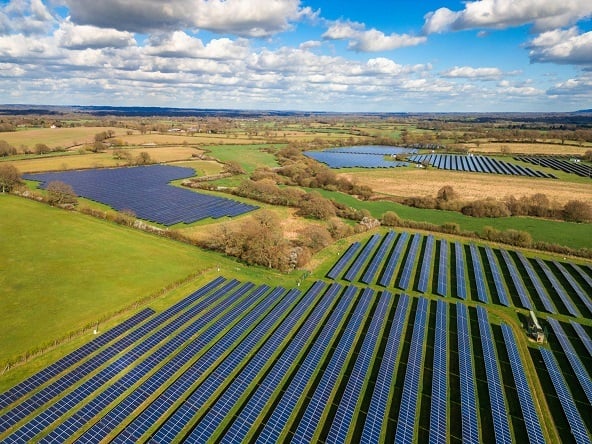
For landowners and farmers weighing up whether to consider a solar energy project on their land, aside from generating new income, the conversation tends to start (and often stop) at planning permission.
While the common questions when considering a solar project, other than the commercial benefits to the landowner, are whether the local planning authority will approve the particular project and whether the neighbours will object. In practice some of the most commercially promising solar projects have stalled not because of planning or objections, but because of something far less visible – infrastructure.
Cable routes, substation access, wayleave agreements and rights over neighbouring land are becoming the issues that determine whether a solar project running across multiple decades is genuinely viable.
Eve Laws, Partner in Thrings’ Clean Energy team looks at the common challenges for solar leases, and why, for landowners, buyers and lenders, understanding these constraints is no longer optional.
Cable routes
A solar park generates electricity, but that electricity needs to travel somewhere. The route it takes – typically underground cables running across fields and roads – can pass through several separate parcels of land before reaching a grid connection point.
Securing a clear, agreed cable route over the landowner’s land early in the development process matters enormously. The landowner will not want to unnecessarily burden more of their land than is necessary because other projects may be considered on adjoining land. Another difficulty is where cabling crosses land belonging to a third party and that landowner refuses access and cabling rights, the developer may face a costly redesign or find the project unviable altogether.
Even where neighbours are broadly willing, late-stage negotiations can introduce delays that undermine the project's financial model.
Substations – more than a technical detail
Before electricity from a solar park can be fed into the national network, it needs to be stepped up in voltage at a substation. Where an existing substation is nearby, connection costs are typically manageable.
Where the nearest suitable substation is several kilometres away, those costs can become significant, sometimes enough to tip a project’s viability.
Finding land for a new substation brings its own complications. Planning permission may be obtained in principle, but without secure access rights and legal agreements in place for the substation site itself, permission alone does not deliver a functioning project.
Easements over neighbouring land
Solar projects frequently need more than just the main site. Cable corridors and access roads may all require land outside the boundary of the farm or estate where the panels are located.
Securing those rights means negotiating easements or temporary licences with neighbouring landowners. An easement is a legal right to use someone else's land for a specific purpose, for example, running a cable beneath a field. Once properly granted and registered, it gives the developer the certainty needed to proceed.
The difficulty is that negotiation takes time, and refusal is always a possibility. A neighbouring landowner who objects to a cable trench crossing their best fields has every right to say no. Disputes over access rights can add months to a project timeline and introduce real financial uncertainty for all parties and so the earlier those discussions start, the better for all involved.
Wayleave agreements
A wayleave is a specific permission that allows a developer or network operator to run power lines – overhead or underground – across private land. Unlike an easement, a wayleave is typically personal to the parties and can, in some circumstances, be terminated.
For a solar project to connect to the grid, wayleave agreements may need to be in place across multiple landholdings. Each must be properly negotiated and clearly drafted, setting out the route, compensation arrangements and maintenance responsibilities.
Without documented wayleaves, a grid connection may be impossible regardless of any planning consent – one of the most common reasons projects stall at an advanced stage.
Grid capacity
Even where planning, cable routes, substations and wayleaves are all in order, a project can still fail if the local grid cannot handle the additional load. Grid capacity in rural areas has become a genuine constraint, and connection queues with network operators can be long. An early grid study is now considered essential practice for any serious solar developer and ensuring this has been carried out may give a landowner further reassurance that a project is viable.
What this means in practice
These infrastructure and access issues do not just affect active solar projects. They are shaping how rural properties are valued, bought and financed. Buyers and lenders now scrutinise access rights and grid connection potential as carefully as planning history.
Existing wayleaves or easements can restrict land use and affect ‘mortgageability’; equally, land with a clear route to grid connection may carry a premium not immediately obvious from the title.
Infrastructure and access arrangements for solar projects agreed now will shape how land can be used and sold for a generation. For landowners approaching a scheme, the straightforward practical advice is to get legal advice before signing anything, ask developers about grid connection early, and check your own title for existing rights.
Thrings’ Clean Energy team includes specialist lawyers from across the firm’s many disciplines, and advises commercial developers, farmers and landowners on the legal aspects of clean energy, environment and to provide a holistic approach to any sustainable project. Find out more and contact us here.